What they find in the next thirty seconds will shape what they think of you, what they write about you, and in many cases, whether they bother at all. That tab, more often than not, leads to your bio.
The Version of You That Shows up When You’re Not There
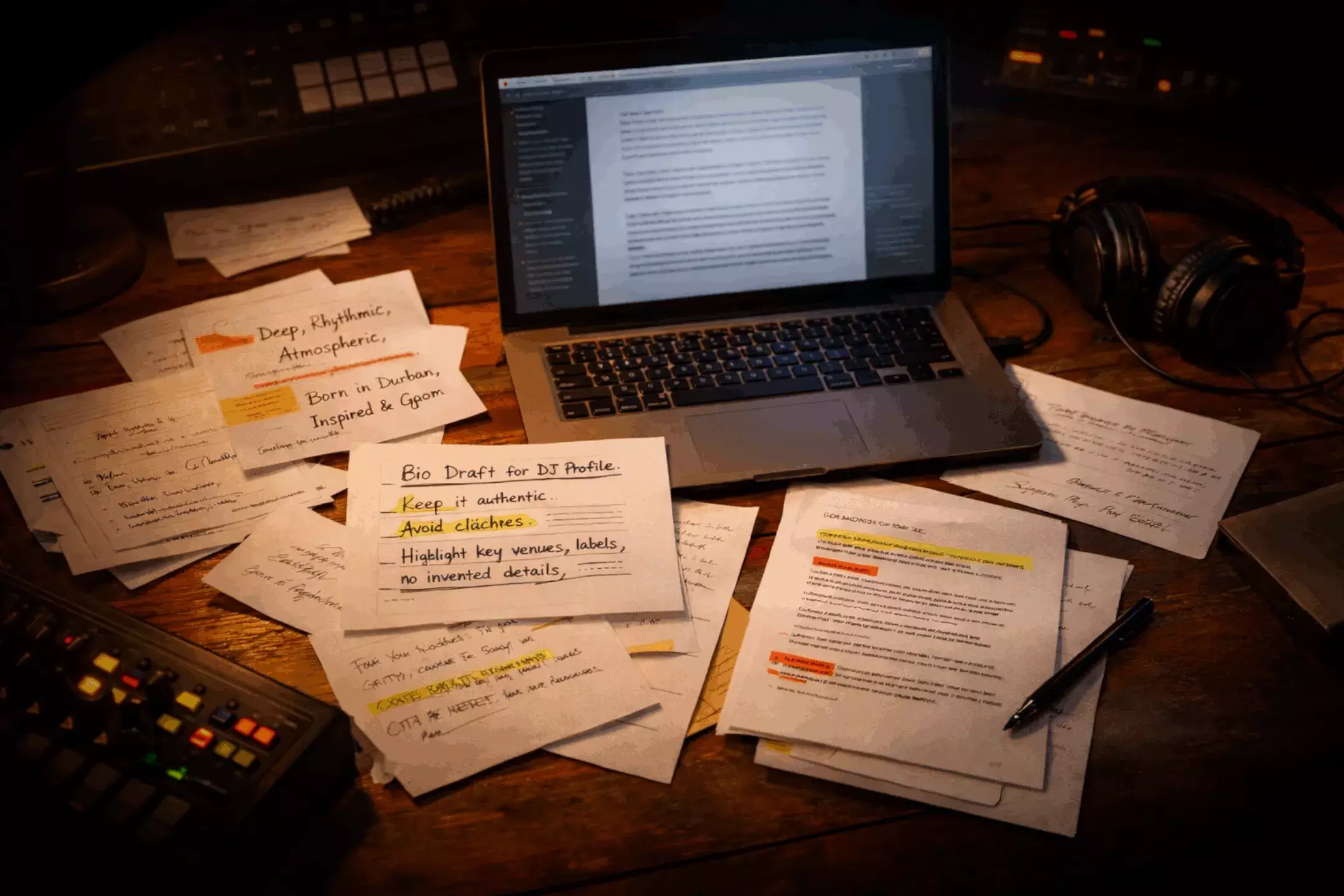
Most musicians treat the artist biography as a formality, something you knock together once and forget about, buried somewhere on a SoundCloud page or in a press kit folder that hasn’t been updated since 2021. It feels awkward to write about yourself in the third person, it’s hard to know what to include, and when you’re staring at a blank page at midnight it’s tempting to just ask ChatGPT to sort it out and move on.
The problem is that none of that reflects what a bio actually is or what it actually does.
Your bio is not a summary of your career. It is not a CV. It is not a list of gigs you’ve played or releases you’ve put out. It is the version of you that shows up when you are not in the room. It is doing your networking, your pitching, and your first impression on your behalf, simultaneously, to people whose attention you cannot afford to waste. It is the document that either makes someone want to know more, or doesn’t. Understanding that changes how you approach it entirely.
Who is Actually Reading This?
Here is something most bio-writing advice glosses over: the people reading your bio are not all looking for the same thing. Your bio needs to work for several different audiences, often from the same single document.
A club promoter or booker is asking one question: is this artist going to serve my crowd and make my night better? They are looking for credibility signals. Have you played rooms like theirs? Do you have a clearly defined sound? Are you a known quantity or an unknown risk? They are not reading your bio for entertainment. They are scanning it quickly for reasons to say yes or reasons to move on.
A music journalist or blogger is looking for an angle. They need a hook, a story, something that makes you interesting to write about beyond “producer releases EP.” They want to know what makes you different, what scene you come from, what you’re trying to do. Give them nothing and they’ll either ignore you or invent something.
A record label or agency is doing due diligence. They want to understand where you sit in the landscape, what you’ve already built, and whether there’s a foundation to work with. They’re looking for evidence that you are an artist with a trajectory, not just a person who makes music.
A corporate or private events client is a different animal altogether. They are not from the industry, they may not know your music at all, and they are primarily managing risk on behalf of a budget and a room full of people they are responsible for. They need to feel confident that you are professional, experienced, and able to read a crowd that didn’t come specifically to see you.
The right bio reassures them on all three counts without alienating the rest of your audience by making you sound like a wedding singer.
And then there’s the new fan, the person who found you through a playlist or a shared mix or a friend’s recommendation, who lands on your profile and wants to know who you are before they commit to caring about you. They are looking for something to connect with. Not a list of accomplishments. A person.
One bio. Five audiences. This is why it matters that you get it right.
What AI Gives You, and What it Doesn’t
Right now, you can open Claude or ChatGPT, type “write me an artist bio for a DJ and producer based in Johannesburg who makes deep house and afro-tech,” and have something back in thirty seconds that is grammatically correct, professionally structured, and completely indistinguishable from a thousand other bios written by a thousand other artists who did exactly the same thing.
That is the problem.
An AI-generated bio written without proper input is not your bio. It is an example of what a bio could theoretically be. It hits the expected marks, uses the familiar phrases, and tells the reader almost nothing about you specifically, because you haven’t told the AI anything about you specifically. It is the musical equivalent of a stock photo: technically fine, but nobody believes it.
There is a place for AI in this process, and we will get to that. Used correctly, with the right preparation, these tools can help you produce something genuinely polished. But that comes later.
Before you can brief a tool, before you can write a word, before you can decide what to include or leave out, there is something more fundamental that needs to happen.
You need to know who you are as an artist.
Not in a vague, abstract sense. Specifically. The sound, the story, the “why,” the thing that makes your version of this music yours and nobody else’s. Without that clarity, every bio you write, whether by hand or by algorithm, will be a placeholder rather than a portrait.
That is where we start.
Next: Part 2: Who Are You? Finding Your Artist Identity Before You Write a Single Word
Credit: JP Vorster – Beatlab Editor
Related Posts

15 June 2026
Know Yourself, Tell Your Story Part 2
Who Are You? Finding Your Artist Identity Before You Write a Single Word. Here…


25 July 2026
Know Yourself, Tell Your Story Part 3
The Three-Bio System – Short, Medium and Full You have done the excavation. You…

31 July 2026
Know Yourself, Tell Your Story Part 4
What Not to Write – The Hall of Shame Part 3 gave you a system: build from the…
11 August 2026
Know Yourself, Tell Your Story Part 5
Using AI the Right Way - How to Brief, Prompt and Evaluate an LLM to Write Your…